ANRF MISSION AI for Science and Engineering (AI-SE)
Introduction:
Anusandhan National Research Foundation (ANRF) is mandated to spearhead a new era of directed Research & Innovation in the country, translating ideas into tangible national and societal outcomes. Under its Mission for Advancement in High-Impact Areas (MAHA) program, ANRF promotes mission-mode, solution-oriented research. The newest flagship initiative under ANRF MAHA is Artificial Intelligence for Science & Engineering (AI-SE) , launched in collaboration with the Ministry of Electronics and Information Technology (MeitY), and Scientific Departments.
Vision:
Objectives:
- Advance next-generation AI methods that directly model science and engineering, including neural operators, physics-informed learning, molecular and biological foundation models, and domain-specific models.
- Accelerate AI-driven discovery in strategic areas such as Climate Science, Advanced Materials, Biomanufacturing, and data-rich fields like microscopy, spectroscopy, medical imaging, astrophysics, and high-energy physics.
- Build an open, interoperable AI ecosystem of scientific models, datasets, tools, and infrastructure to embed and share scientific insights across domains.
- Catalyse cross-disciplinary collaboration to integrate AI research with domain expertise, advance the science of AI (including generative AI and domain adaptation), and strengthen India's scientific and technological self-reliance.
- Creation of a coherent set of opensource fundamental models and datasets for science and engineering.
Significance of the Mission:
This Mission positions AI as an integral component of the scientific and engineering enterprise -where scientific principles, engineering designs, data, and models are directly embedded in AI systems-thereby advancing both the frontiers of science/engineering and the science of AI to accelerate discovery, innovation, and national technological self-reliance.
Scope of the Mission:
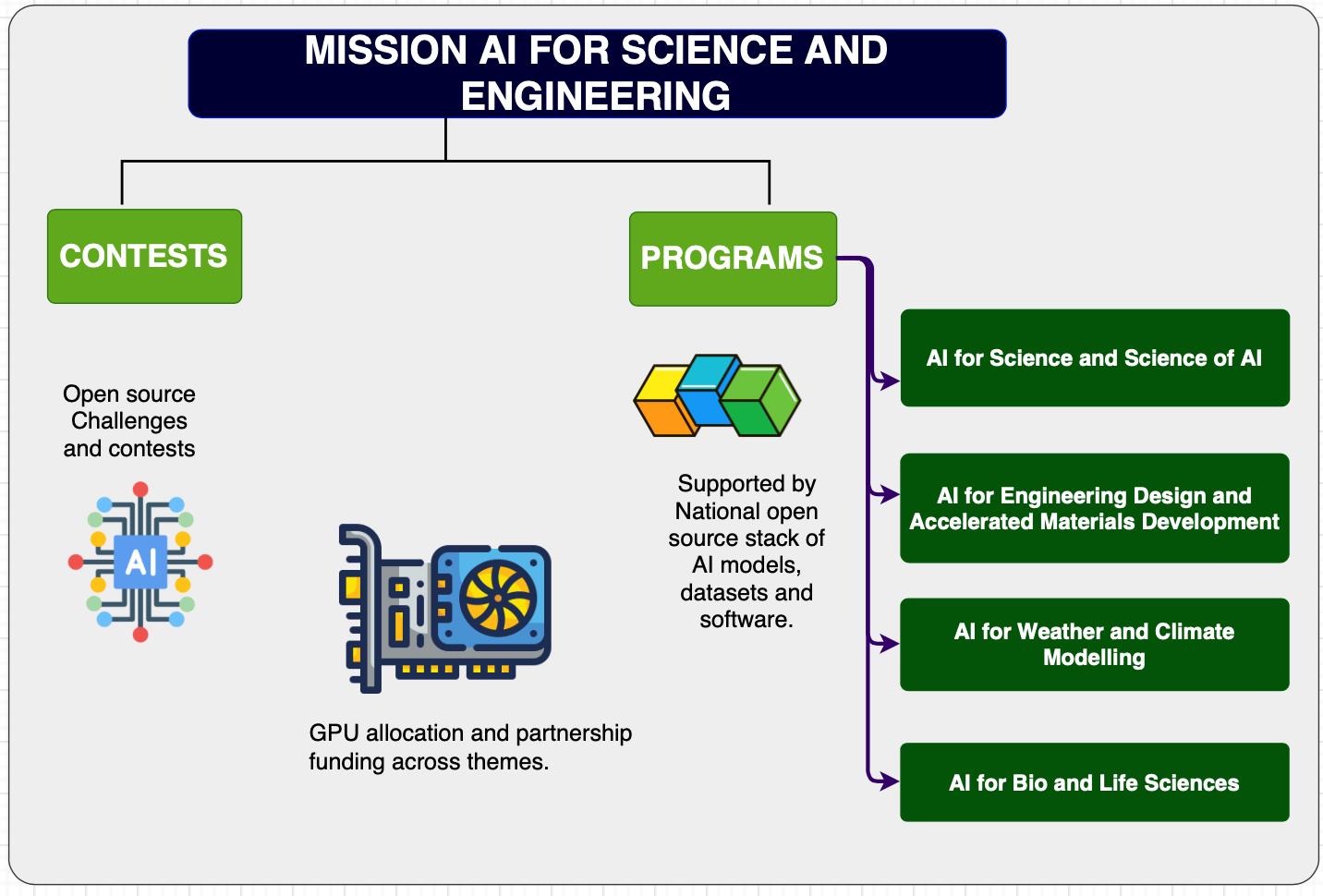
The Mission adopts an interlinked support architecture through various domain specific programs.
The Mission will drive cutting-edge AI research, backing academia and research institutions to develop fundamental building blocks in science and engineering. This includes exploring novel architectures like domain-centric neural operators, sophisticated large-scale models tailored for specific knowledge domains in science and engineering, and AI-powered experimental platforms and digital twins.
The projects identified under the programs will be open for funding support by ANRF and/or partner scientific departments such as Ministry of Earth Sciences (MoES), Department of Biotechnology (DBT) and Defence Research & Development Organization (DRDO), based on the areas of interest. More entities including non-governmental organizations will be added to the mission as program partners, in future.
Projections for the programs include scalable GPU clusters supported by MeitY, a federated data backbone built on FAIR (Findable, Accessible, Interoperable, and Reusable) principles, and an open-source ecosystem of models, tools, and autonomous laboratories for machine-speed validation. These elements converge in the Open IndiaAI Stack, a composable catalogue of models, datasets, and workflows that function like snap-together "LEGO blocks. These lego blocks can be composed into domain specific AI agents via automated AI techniques.
Proposals are invited under the following tracks:
Track I: Programs (in Partnership with MeitY for GPUs):
Program I: AI for Science and Science of AI (ANRF)
- Hybrid AI-HPC Approaches for Scientific Discovery
- Reimagining Design and Simulation through AI
- AI for Next-Generation Batteries and Sustainable Energy Storage
- AI for Medical Imaging
- AI for Computational Chemistry
- AI for Astrophysics, Cosmology, Nuclear and High Energy Physics
- AI-guided Molecular Design or Quantum phenomena
- AI methods inspired by Scientific Disciplines
- AI for Earth & Geological Sciences & Engineering
- AI for Multi OMICS for Plant and Animal Sciences
- AI for Mathematics and Mathematical Reasoning
Program II: AI for Engineering Design and Accelerated Materials Development (ANRF with DRDO)
- Accelerating Materials Discovery and Optimization with AI
- Novel Materials design through AI for defence applications
- Digital Twins for naval systems like AIP, advanced propellers, unmanned underwater systems
- Real-time fluid dynamics modeling
- AI-enabled design and maintenance of maritime systems
Program III: AI for Weather and Climate Modeling (ANRF with MoES under Mission Mausum)
- AI emulators for physics parameterization and earth system models
- Multimodal rainfall nowcasting
- Climate modeling and environmental forecasting
Program IV: AI for Bio and Life Sciences (ANRF with DBT)
- Biomanufacturing
- AI-assisted strain selection and yield optimization
- Enzyme design and biocatalysis
- AI for Drug Discovery and Cell & Gene Therapies
- AI for Computational Biology
- AI for Protein and mRNA biologics
- AI for Therapeutics and Vaccines
- Proposals must be collaborative, demonstrating strong expertise in both core Sciences or Engineering and AI, and may involve multi-investigator or multi-institutional consortia. Proposals featuring meaningful collaboration with startups and industry partners will be actively encouraged over purely academic proposals.
- Proposals relying solely on pre-2020 "black box" machine learning approaches (e.g., basic machine learning and regression models, shallow neural networks, or standard convolutional/recurrent neural networks (CNN)/(RNN) pipelines) will not be prioritized for support. Proposals are expected to use modern AI methods (post-2020) that reflect the state of the art in scientific applications, transfer learning or emergent properties etc. Fine tuning of open source state of art foundation models is also encouraged using specialized data sets.
- Research grants of up to Rs 30 Crore for a period of 3 years may be awarded, inclusive of GPU usage costs. In rarer cases, upto Rs 50 Crore will also be considered, commensurate with the projected deliverables and impact of the proposal.
- The budgetary provision for GPU usage must not exceed 70% of the total project cost.
- GPU usage will be supported only through MeitY's GPU-as-a-Service; purchase of GPUs or other HPC equipment will not be funded.
- Funding will cover Research Personnel (JRFs, SRFs, RAs/National Post Doctoral Fellows (NPDFs), Project Scientists etc.), AI/cloud compute hours, software tools, datasets, and experimental rigs. Additional allowable costs include travel, contingency, and institutional overheads as per ANRF norms.
- Funding may also cover on-demand HPC services through National Supercomputing Mission, to support experimental validation and hybrid science-in-the-loop approaches.
- Proposals with high capital cost requirements will not be supported.
- Duration of the projects shall not exceed 3 years.
- Project proposals are invited in consortium mode, bringing together multiple Principal Investigators (PIs) and institutions/laboratories from academia, research organizations, industry, and startups.
- Each proposal must be submitted by a lead institution and will be headed by a lead PI.
- The lead PI will be from the academic institution or a National Research Laboratory, and must hold a regular position in the institution. The PIs can also be from Section 8 Companies and DSIR SIRO registered entities.
- Applicants must be Indian citizens or OCI holders.
- Applicants must have a Ph.D. in Science, Mathematics, Engineering, or relevant Social Sciences (for AI in quantitative social sciences) or M.D./M.S./M.D.S./M.V.Sc. degree holders.
- PIs nearing superannuation may apply if supported by a Co-PI from the same institution with at least 3 years of service remaining. Fellows under INSPIRE, Ramanujan, and Ramalingaswamy schemes may participate as Co-PIs.
- Each proposal must have one Lead PI and may include up to a maximum of six Co-PIs. These Co-PIs may belong to the same institution as the Lead PI or may be drawn from multiple collaborating institutions. This provision is intended to support the formation of strong, interdisciplinary, and multi-institutional research teams, to achieve target outcomes.
- The person from Industry, startups, international faculty/researcher/industry can formally be a "Honorary PI" in collaboration with a lead PI in India, but the role of Honorary Investigator should be defined in the proposal.
- The lead institution will be responsible for the financial and administrative management of the project.
- Post selection of the project, funds will be allocated to lead institution, which will in turn be distributed to other academic/ R&D lab partners, as required.
- Collaboration: Startups and Industry partners are invited to participate in the mission as a collaborating partner with academic institutions/ R&D labs and can aim to leverage open-source outputs of the mission to drive their innovation. No financial support will be provided for industry and startups by ANRF in this mission.
Each supported project must produce either an open-source model or an open-source dataset or its combination thereof, as its primary deliverable. Every proposal should include four mandatory dimensions:
- Technical Efficacy - accuracy, speed, and robustness measured on peer-reviewed benchmarks or, where those are absent, on pre-agreed data;
- Open-Science Contribution - code, checkpoints, and datasets released under approved licenses, together with reproducibility scripts
- Technology Readiness - attainment of TRL milestones aligned with the project's declared pathway to deployment.
- All funded projects will be required to contribute at least one well-defined benchmark task or an open-source model to support open source competitions in Track - II.
- The PIs/Co-PIs must commit to releasing intermediate artefacts under approved open-source licenses.
The details of the licence can be found here.
- Under the Mission, a lead PI is eligible to submit only one proposal during a given call.
- Information to be provided for pre-proposal:
Section A: Objectives, Technical efficacy benchmarks including TRLs, planned open-science contributions, deliverables, impacts, and milestones with a clear deployment pathway (maximum 3 pages).
Section B: Budget Requirements
Part I - Proposed GPU usage requirements and envisaged costs, with technical justifications (maximum 1 page). Principal Investigators (PIs) can calculate the usage costs through the India AI Compute portal.
Part II - Details of other costs (Non-recurring, Consumables, Travel, Contingency, Research Personnel, and Overheads) (Maximum 1 page).
- Full proposals will be invited by ANRF, based on the evaluation of the pre-proposals.
- The proposals will be evaluated by a domain-specific Technical Advisory Committee (TAC), and applicants may be invited for presentations or discussions as part of the selection process.
All proposals submitted under the AI-SE Mission must be entirely original in both concept and content, reflecting the applicant's own research ideas, methodologies, and planned activities. Proposals found to contain any uncredited or unattributed copied content, whether from published literature, online sources, or previously submitted work, will be summarily rejected without further review.
Proposals must be submitted through www.anrfonline.in and will be evaluated under ANRF's standard procedures, aligned with the implementation strategies of this Mission. Applicants should carefully review the detailed PI guidelines on the portal to ensure full compliance with submission requirements and formats.
National Challenges through open source contests: Under the broad umbrella of the AI-SE mission, open source challenges and contests will be undertaken to build a national common of open-source AI models, datasets, and evaluation benchmarks. Grand challenges, public competitions, and community benchmarking will be the goal of this initiative. A key purpose of this effort is to foster the engagement of the wider scientific community and latent talents, including researchers, students, and innovators from Tier II and Tier III institutions and universities, thereby ensuring inclusive participation and broad-based capacity building in AI for Science and Engineering.
Nature of Support for Contests and Challenges:
- The mission will have national competitions over the year, to build open-source AI datasets, build opensource models, and benchmarks.
- Around 10 national competitions over the year will be targetted.
- The competitions are open to all Indian citizens or OCI holders.
- The competitions will entail prizes and access to GPUs through MeitY's shared infrastructure.
- The expected deliverables will be build datasets or build models for opensource.
- The applicants should affiliate/partner with any Indian academic institutions ornational research labs if they win the contest, for GPU access/allocation.
- The PIs/Co-PIs must commit to releasing intermediate artefacts under approved open-source licenses. The details of the licence can be found here...
Implementation of Open Source Challenges and Contests:
- ANRF and MeitY will evolve mechanisms to support competitions to lead the development of national open-source AI models, datasets, and benchmarking platforms, including large-scale competitions to crowdsource innovation. In addition ANRF and MeitY may procure support services for this AI Mission.
Operational details will be informed shortly.
Q1: Who can apply as a Principal Investigator (PI)?
A1: Applicants must be Indian citizens or OCI holders. The Lead PI must hold a regular position in an Indian academic institution or national research laboratory, with a Ph.D. in Science, Mathematics, Engineering, Social Sciences (quantitative AI), or equivalent medical degrees (M.D./M.S./M.D.S./M.V.Sc.)
Q2: Can a PI nearing retirement apply?
A2: Yes, but only if supported by a Co-PI from the same institution who has at least 3 years of service remaining.
Q3: Can startups and industry partners apply?
A3: Yes, but only as collaborators with academic or R&D institutions. They cannot receive direct funding but may leverage open-source outputs of the mission.
Q4: Can a PI submit a proposal individually?
A4: No, leading PI has to submit a proposal in collaboration with other PIs and other Institutions.
Q5: Will international collaborators be encouraged to contribute without any financial obligations from either end?
A5: Certainly. If accomplished international researchers wish to collaborate with the PI/Co-PIs to contribute to the project, they are welcome, without any financial obligation from ANRF.
Q6: Is a prior clearance (Ethical, biosafety, animal, humans, etc) required at the time of submission of proposals?
A6: The clearances may be submitted after approval of the proposal for funding.
Q7: Who can serve as a Co-PI in a consortium proposal?
A7: Faculty/scientists from eligible institutions with relevant expertise/complementary expertise can serve as Co-PIs.
Q8: What is the eligibility of Co-PI?
A8: The Co-PI must hold a regular position in an Indian academic institution or national research laboratory, with a Ph.D. in Science, Mathematics, Engineering, Social Sciences (quantitative AI), or equivalent medical degrees (M.D./M.S./M.D.S./M.V.Sc.).
Q9: Can a PI submit more than one proposal under the same call?
A9: PI can submit not more than one proposal as lead PI, and can submit upto two proposals as Co-PI.
Q10: Are ad-hoc, contractual, or temporary faculty eligible to apply?
A10: Yes, ad-hoc, contractual or temporary faculty can apply in a project as honorary investigator or collaborator not as s Co-PI.
Q11: Can applicants without institutional affiliation apply?
A11: No. Applicant should be affiliated with a recognized institute/University.
Q12: Can multiple proposals be submitted from the same institution?
A12: Yes. Institutions can submit multiple proposals from different PIs.
Q13: Is there a limit on the number of Co-PIs in a consortium?
A13: Yes. Up to 6Co-PIs are allowed.
Q14: Is an endorsement letter required for each participating PI?
A14: Yes. There is no requirement of any documents during the pre-proposal submission stage, however institution endorsement/ certificate from the PI/Co-PI and other approval will be required during full proposal submission. The pre-proposal should be shortlisted for full proposal submission.
Q15: Can a PI change their host institution after submission?
A15: Not at pre-proposal stage. This is permitted only after formal approval of ANRF.
Q16: Can two PIs from the same institution submit separate proposals?
A16: Yes, if they are distinct and unrelated proposals.
Q17: Are autonomous institutes under central/state governments eligible?
A17: Yes, fully eligible.
Q18: Are private universities eligible to apply?
A18: Yes, if they are UGC/AICTE-recognized.
Q19: Are R&D labs under ministries eligible to participate?
A19: Yes, they are eligible.
Q20: Are foreign nationals working in Indian institutions eligible to apply?
A20: Yes, if they hold full-time appointments and residence permits.
Proposal Submission Process
Q21: Is the call structured as pre-proposal followed by full proposal?
A21: Yes, it is a two-stage process.First proposals will be evaluated and only shortlisted pre-proposal will be invited for full proposal submission.
Q22: What are the mandatory documents required at the pre-proposal stage?
A22: Other Technical Details (OTD) as per format only.
Q23: What file formats are accepted by the portal?
A23: Mostly PDF as specified on the portal.
Q24: Is a detailed budget required in the pre-proposal?
A24: No. Only a high-level budget summary is needed as per the OTD format during preproposal submission.However detailed budget with bifurcation to each participating institution should be proposed at full proposal submission.
Q25: Can applicants edit or revise the proposal after submission?
A25: No. Once submitted, it cannot be edited.
Q26: Can proposals be jointly submitted by two or more institutions?
A26: Yes, through the consortium model.
Q27: What is the maximum size allowed for uploads on the portal?
A27: As specified on the portal (max size 20 MB).
Q28: Can the PI add or replace Co-PIs after submission?
A28: Not at pre-proposal stage. Allowed only at full proposal stage with justification& consent of Co-PI.
Q29: Is it mandatory to submit a Gantt chart at the pre-proposal stage?
A29: Not mandatory but recommended.
Q30: Is a Letter of Intent (LoI) required from industry partners?
A30: Yes, at the time of submission of full proposal.
Q31: Can international collaborators be included?
A31: Yes. They can participate as collaborators/ Honorary investigators. However, the proposal does not entail any funding to international collaborator.
Q32: Can a proposal be withdrawn after submission?
A32: Yes, with a written request through online portal.
Q33: Is it mandatory for all consortium partners to register on the portal?
A33: Yes. All participating institutions must register on the ANRF portal.
Q34: Can a PI change the thematic vertical after submission?
A34: No. It can not be changed.
Q35: Is plagiarism checked during proposal evaluation?
A35: Yes. High similarity index may lead to rejection.
Themes & Scope (Research Areas)
Q36: What thematic verticals are included under AI-SE?
A36: Program I: AI for Science and Science of AI (ANRF)
- Hybrid AI-HPC Approaches for Scientific Discovery
- Reimagining Design and Simulation through AI
- AI for Next-Generation Batteries and Sustainable Energy Storage
- AI for Medical Imaging
- AI for Computational Chemistry
- AI for Astrophysics, Cosmology, Nuclear and High Energy Physics
- AI-guided Molecular Design or Quantum phenomena
- AI methods inspired by Scientific Disciplines
- AI for Earth & Geological Sciences & Engineering
- AI for Multi OMICS for Plant and Animal Sciences
- AI for Mathematics and Mathematical Reasoning
- Accelerating Materials Discovery and Optimization with AI
- Novel Materials design through AI for defence applications
- Digital Twins for naval systems like AIP, advanced propellers, unmanned underwater systems
- Real-time fluid dynamics modeling
- AI-enabled design and maintenance of maritime systems
- AI emulators for physics parameterization and earth system models
- Multimodal rainfall nowcasting
- Climate modeling and environmental forecasting
- Biomanufacturing
- AI-assisted strain selection and yield optimization
- Enzyme design and biocatalysis
- AI for Drug Discovery and Cell & Gene Therapies
- AI for Computational Biology
- AI for Protein and mRNA biologics
- AI for Therapeutics and Vaccines
Funding & Budget
Q37: Who will fund the projects under the AI-SE Mission?
A37: The primary funding for projects under the AI-SE Mission will be provided by ANRF. MeitY will partner in the program by providing GPU resources through its India AI Mission. Additionally, partner departments such as MoES, DBT, and DRDO will co-fund projects alongside ANRF within their respective verticals, in coordination with MeitY.
Q38: What is the maximum funding available?
A38:
- Up to Rs 30 Crore for 3 years.
- In exceptional cases, up to Rs 50 Crore may be awarded.
Q39: What costs are covered under the grant?
A39: The funding covers:
- Research personnel (JRFs, SRFs, RAs, NPDFs, Project Scientists)
- GPU/cloud compute hours (via MeitY's GPU-as-a-service)
- Software tools, datasets, experimental rigs
- Consumables, Travel, contingency, and institutional overheads (As per ANRF norms)
Q40: Can I purchase GPUs with project funding?
A40: No. GPU usage will only be supported through MeitY's GPU-as-a-service. Direct purchases of GPUs or HPC systems are not allowed.
Q41: Is there a cap on GPU usage costs?
A41: Yes. GPU usage cannot exceed 70% of the total project budget.
Q42: Are high-capital projects (like new HPC clusters) supported?
A42: No. Proposals with heavy capital expenditure will not be supported.
Q43: How can I calculate the GPU usage charges?
A43: The GPU usage charges can be calculated through the India AI mission's AI Compute portal (Link: https://compute.indiaai.gov.in/indiaaipricecalculator)
Q44: Can manpower be hired under the project?
A44: Yes as per ANRF norms.
Q45: Is data procurement allowed?
A45: Yes, with clear justification.
Q46: Are travel expenses supported?
A46: Yes, for project-related travel.
Q47: Are international visits allowed?
A47: Yes, as per ANRF norms.
Q48: Is contingency allowed?
A48: Yes, as per ANRF norms.
Q49: Are overhead charges applicable?
A49: Yes, as per ANRF norms.
Q50: Are industry partners required to invest financially?
A50: Not mandatory.
Q51: Are consultancy or honorarium charges allowed?
A51: No.
Industry & Startup Participation
Q52: Is an industry partner mandatory?
A52: No, but strongly encouraged.
Q53: What types of industries are eligible?
A53: Startups, MSMEs, large firms, and domain-relevant companies.
Q54: Can startups join a consortium?
A54: Yes. Startups can participate as collaborators/ Honorary investigators.
Q55: Can startups apply directly as PI?
A55: No. Only faculty/ scientists from academia/ research labs can apply as PI/ Co-PI.
Q56: Are industry partners eligible for funding?
A56: The program does not entail funding to Industry Partners/Startups.
Q57: What documents are needed from industry?
A57: LoI/Support Letter/MoU at the time of submission of full proposal.
Q58: Can multiple industry partners be included?
A58: Yes.
Q59: Can foreign industry join?
A59: Yes, as collaborators/ Honorary investigators.
Q60: Can industry provide datasets or infrastructure?
A60: Yes, this is encouraged.
Proposals & Deliverables
Q61: What must each funded project deliver?
A61: Each project is expected to deliver:
- An open-source model, dataset, or both
- Technical benchmarks (accuracy, speed, robustness)
- Open-science contributions (code, checkpoints, reproducibility scripts)
- Clear Technology Readiness (TRL) milestones, if any.
- Contributions to Track II (benchmarks or open-source models)
Q62: Are proposals based on older machine learning methods admissible?
A62: No. Proposals relying only on pre-2020 "black box" ML approaches (basic regression, shallow neural networks, CNN/RNN pipelines) will not be prioritized. Applicants must use modern, state-of-the-art AI methods (post-2020), such as foundation models, transfer learning, domain adaptation, or physics-informed learning.
Q63: Are projects on AI for engineering processes admissible?
A63: Yes. The goal of the project is open AI models for key chip design processes, or associated creation of open data sets, i.e. it is formulated as a direct modelling of engineering, then it could be admissible. Please note that several aspects of engineering: mass flow, heat flow, fluid flows, or P&ID diagrams for chemical processes etc could be directly modelled in AI in different ways, and ultimately leading to open digital twins. While we have given several examples, our intent is not to be restrictive. However we expect applicants to justify what open AI model (that directly models science or an engineering process) or open data set is being created in the proposed application.
Q64: What is the format for a pre-proposal?
A64:
- Section A (3 pages): Objectives , methodology, benchmarks, planned open-science contributions, deliverables, Impact and milestones with a clear deployment pathway (maximum 3 pages).
- Section B (2 pages): Budget (separate budgets for (a) GPU usage and (b) other costs)
Q65: When to submit a full proposal?
A65: A full proposal should be submitted only if your pre-proposal is selected. Pre-proposals will undergo a preliminary screening to assess their alignment with the mission's scope and objectives, as well as their technical merit and potential impact. Only those pre-proposals that pass this evaluation will be invited to submit a full proposal.
Policies & Compliance
Q66: Under what license must outputs be released?
A66: All outputs must be released under the ANRF Open License (adapted from MIT), ensuring open access, ethical use, and global interoperability.